

© 2025 Palestine Center for Public Policy
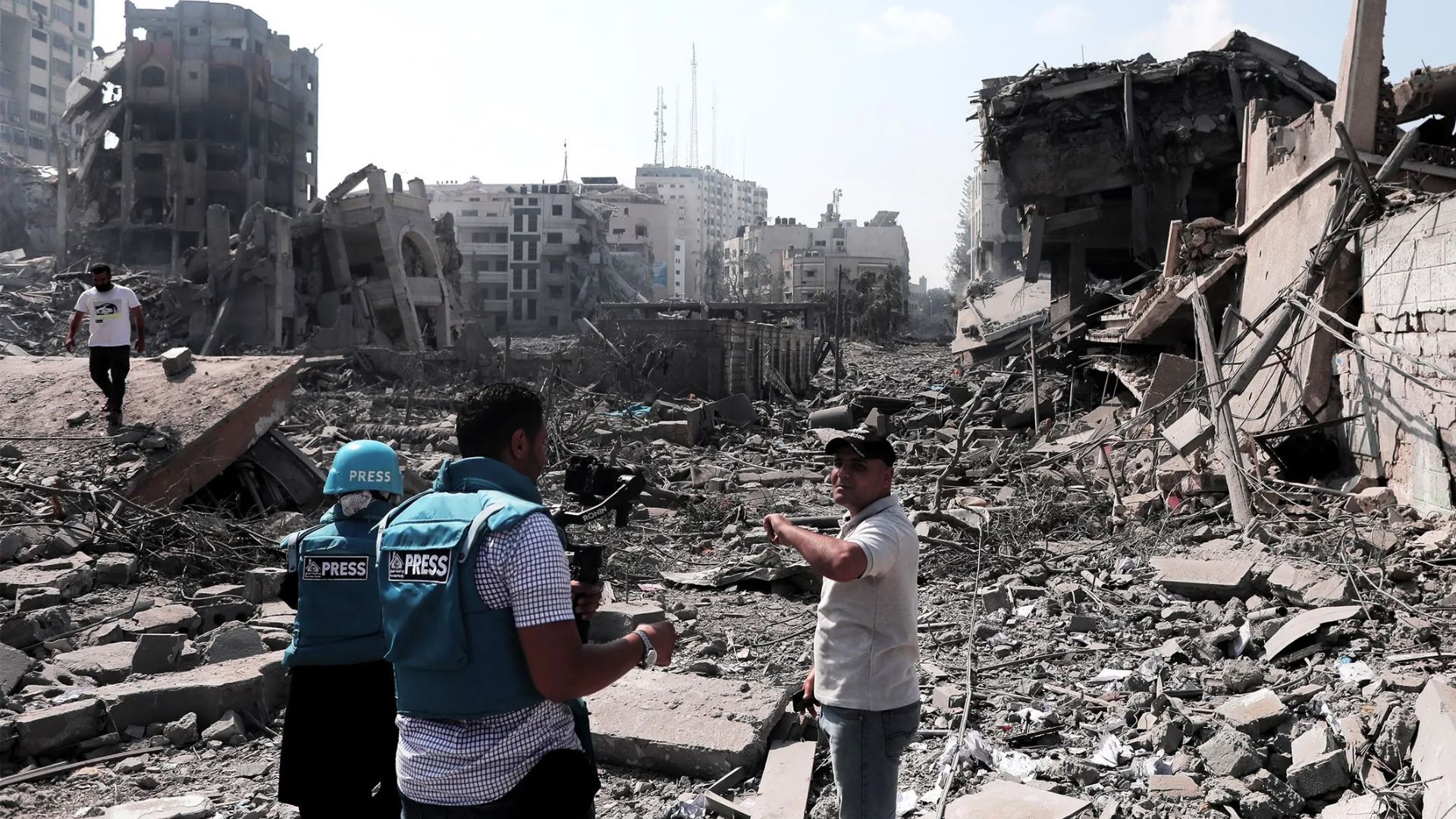

Since October 2023, Israel's military operations in Gaza have intensified to unprecedented levels, leading to what many legal experts and human rights organizations have identified as acts of genocide. This classification is based on the evidence that shows the deliberate targeting of civilians, hospitals, medical personnel, mass displacement, and the intentional blockade of humanitarian aid; all actions align with the definitions outlined in the 1948 Genocide Convention. Despite this, leading Western media outlets, including The New York Times, BBC, Reuters, and The Washington Post, have largely avoided using the term “genocide” in their coverage.
This brief outlines the consequences of this editorial exclusion, the distortion of public understanding, the obstruction of international legal accountability, and the erasure of the Palestinian narrative. It advocates for editorial transparency, legal precision, and balanced representation in mainstream media, alongside the consistent coverage of the ongoing violence in the West Bank.
Since 1967, Israel has maintained a brutal military occupation over Palestinian territories, including the Gaza Strip, which has faced repeated bombardments and sieges. Most recently, following the incidents of October 7th, the Israeli government launched a massive military assault on Gaza. This has resulted in what human rights organizations and legal experts describe as genocide against the Palestinian people, with a recent analysis in The Lancet estimating up to 186,000 excess deaths in Gaza as of July 2024. Amnesty International's landmark report, "You Feel Like You Are Subhuman: Israel's Genocide Against Palestinians in Gaza," documents the extent of violence and destruction inflicted on Gaza's population, presenting clear evidence of the intent to destroy Palestinians through acts prohibited by the Genocide Convention. Despite this obvious evidence, including deliberate killings, infliction of pain, and the imposition of conditions intended to lead to physical destruction, the major media news outlets have largely failed to recognize the severity of the situation as genocidal.
In the early days of the war, President Biden reported unverified claims, including allegations of beheaded babies, originating from media misreporting, which shaped U.S. public perception and justified escalated military aid to Israel. During an October 11 roundtable with Jewish leaders, Biden states, “I never really thought that I would see, have confirmed, pictures of terrorists beheading children.” However, the White House later walked back this statement, clarifying that neither the president nor U.S. officials have seen such images and his remarks were based on Israeli government claims and media reports. These unverified narratives, fueled by sensational reporting from outlets like i24, spread widely, prompting headlines in major Western newspapers and providing rhetorical cover for the collective punishment of civilians in Gaza. Meanwhile, Palestinian civilians have endured sexual violence, mass detentions, and systematic assaults, realities that are absent from the U.S. political discourse and largely ignored by humanitarian outrage.
The BBC, The New York Times, The Washington Post, and Reuters frame the events without invoking the term “genocide”; this paper argues that this exclusion distorts public perception, shields political actors from accountability, and contributes to the erasure of Palestinian suffering. The selective use of terminology perpetuates an implicit bias that minimizes Israeli government operations while disregarding established legal frameworks that constitute genocide. To maintain ethical journalistic standards and accurately depict international law, media organizations must prioritize legal precision, editorial transparency, and a dedication to impartial and responsible journalism.
Furthermore, mainstream media coverage continues to sideline the reality of ongoing violence in the occupied West Bank, where Palestinian homes are routinely demolished and civilians, including women and children, are killed or detained in near-daily military raids. It is crucial to understand that the occupation of the West Bank predates the events of October 7, 2023; the violence and oppression in this region have been ongoing for decades. To uphold ethical journalistic standards and international law principles, media organizations must implement editorial policies that reflect legal realities, provide balanced coverage, and resist political pressures that contribute to narrative bias.
This brief draws on a content analysis of Gaza coverage across major Western media outlets (BBC, NYT, Washington Post, Reuters), legal definitions from the 1948 Genocide Convention, and statements from international legal experts and NGOs. It also includes testimony from Palestinian on-the-ground sources and reports from non-governmental organizations, as well as academic research on media framing and bias in conflict journalism.
Editorial Language Restrictions
Across major Western outlets, including The New York Times, BBC, Reuters, and The Washington Post, coverage of Israel's attacks on Gaza demonstrates a systemic avoidance of legal terms like "genocide," despite evidence from Amnesty International, Human Rights Watch, and legal scholars. While these outlets often cite civilian death tolls and humanitarian crises, they consistently refrain from applying legal terminology, such as the term “genocide,” even when credible evidence aligns with international legal definitions.
A leaked internal memo from The New York Times, reported by The Intercept, reveals institutional editorial policies that actively discourage journalists from using terms like "genocide," "ethnic cleansing," and "occupied territories" in their coverage of Gaza. Reporters were instructed to avoid using the word "Palestine" except in rare cases and to avoid referring to Gaza refugee settlements as "refugee camps," even though the UN recognizes them.
Disproportionate Framing of Violence
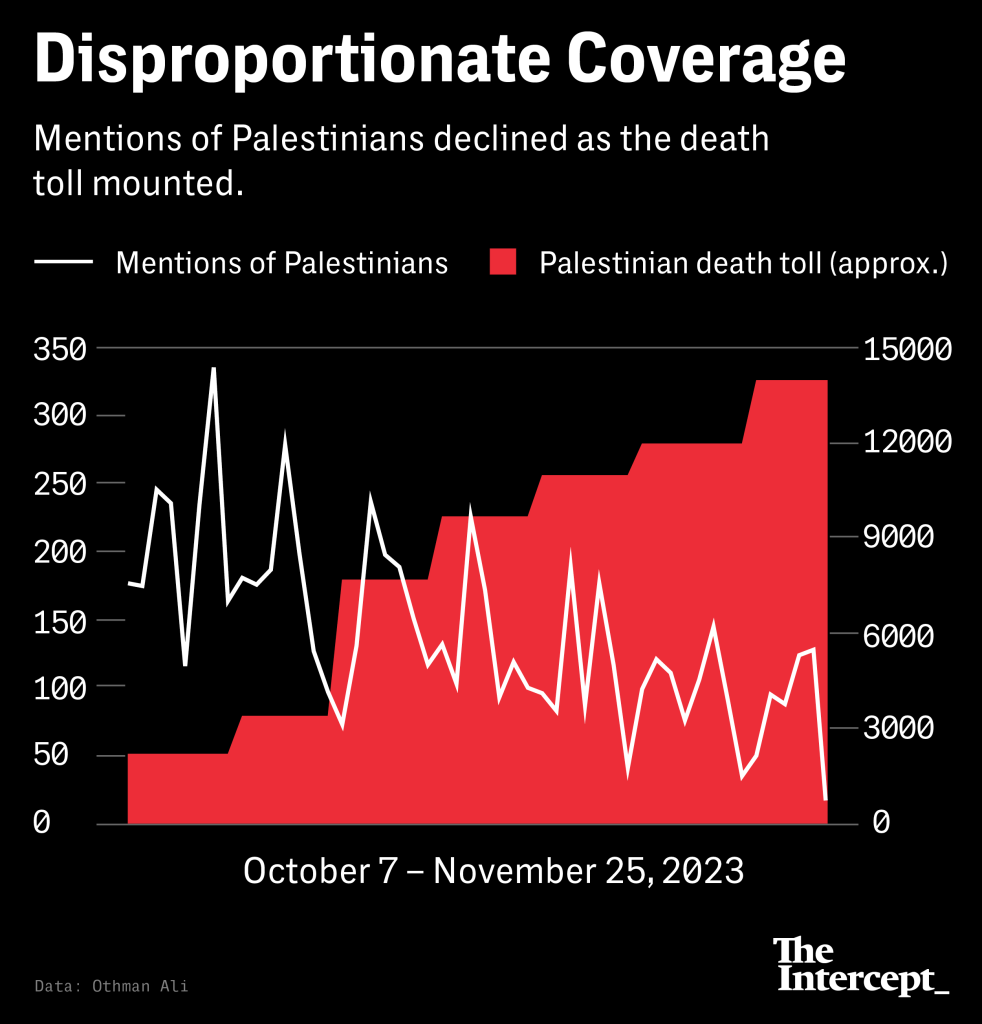
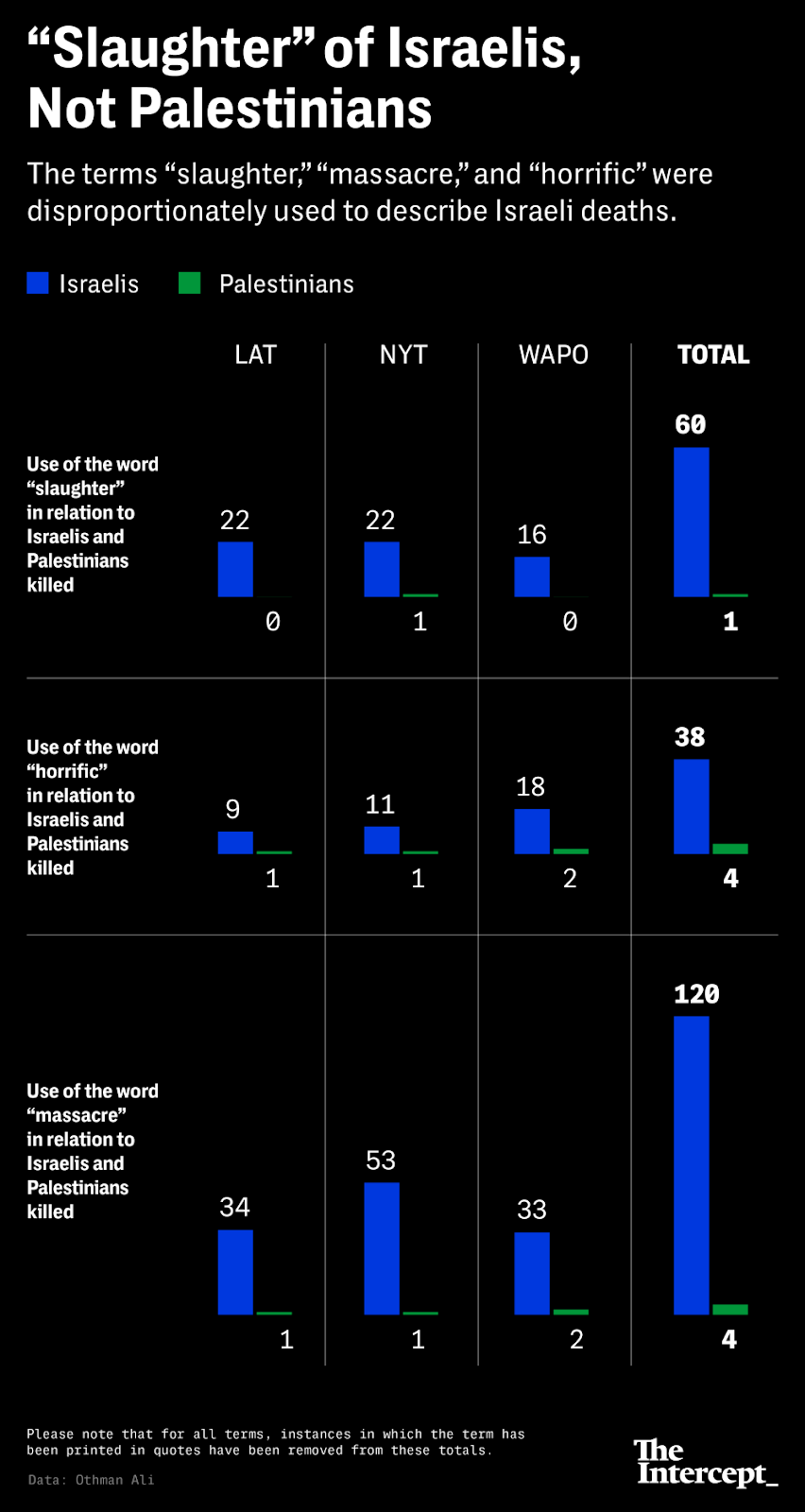
An analysis by The Intercept found that U.S. outlets disproportionately used emotionally charged words like “ slaughter,” “massacre,” and “horrific” to describe Israeli deaths, while rarely applying the same language to Palestinian deaths, even when casualties among Palestinians were significantly higher.
Figure 1: Disproportionate U.S. Media Coverage and Language Bias in Gaza War Reporting
Case Study: The New York Times Headlines
The New York Times headlines for the October 7 incident and the Palestinian casualties in Gaza had a stark contrast in tone. The headline, "They Ran Into a Bomb Shelter for Safety; Instead, They Were Slaughtered" used an emotionally charged word, “slaughtered,” to highlight the horror of the violence against Israeli civilians. In contrast, the headline "The War Turns Gaza Into a 'Graveyard' for Children" adopts a more dispassionate tone, quoting the UN and utilizing the passive voice. As the Intercept noted, this softer phrasing removes direct blame for the violence, distances the reader from the perpetrators, and reduces the emotional impact when compared to the October 7 coverage. Furthermore, the report on Palestinian casualties is limited, using phrases such as "killing dozens" or "causing casualties" without fully conveying the scope of the devastation.
This reflects a broader trend in media coverage, in which Palestinian suffering is frequently framed in a more impersonal manner, indicating that the media tends to adopt a more sympathetic tone toward Israel's actions while remaining more detached when reporting on Palestinian suffering.
Underplaying Israel’s actions
The denial of what constitutes genocide minimizes the gravity of Israel's military actions and contributes to the implicit bias that diminishes Palestinian suffering; failure to recognize the legal dimensions of Israel's actions distorts public awareness of the conflict. Included statements like “This follows Hamas’s repeated refusal to release our hostages, as well as its rejection of all the proposals it has received from US presidential envoy State Witkoff and the mediators” minimize Israel's military actions and portray them as a response to Hamas when, in fact, civilians are being targeted. By shifting blame to Hamas, the article avoids an examination of Israel's role in the escalation of violence.
The 1948 United Nations Convention on the Prevention and Punishment of the Crime of Genocide defines genocide as the systematic targeting of civilians and widespread devastation in Gaza, which is consistent with this definition. Legal scholars such as William Schabas argue that genocide is not limited to isolated incidents but includes a pattern of actions intended to destroy people, which fits the description of Israeli military operations in Gaza, where Palestinian civilians have been deliberately targeted and their infrastructure systematically destroyed.
Furthermore, this framing dismisses the simultaneous and ongoing violence in the occupied West Bank, where settler attacks, home demolitions, military raids, and civilian deaths—including women and children—go largely unreported. The occupation and dispossession in the West Bank did not begin on October 7, 2023, nor was it limited to Gaza; it is part of a decades-long system of apartheid and colonial violence.
Media Bias
The New York Times (NYT) report, “Israeli Airstrikes Hit Marketplace and Mosques in Gaza, Killing Dozens,” presents a factual recount of the airstrikes in Gaza. Still, editorial choices show pro-Israel bias in their portrayal of the ongoing genocide. Despite the enormity of destruction and loss of life in Gaza, the article's editors made the editorial decision to avoid using emotionally charged phrases like "genocide." The report notes the killing of at least 687 Palestinians, including 140 children and 105 women. Still, it does not refer to the violence as genocide, even though several international human rights organizations have used that term to describe Israel's current military operations in Gaza. By omitting the use of the term "genocide," the report distances itself from the severe moral and legal consequences that such a term would imply, preventing readers from viewing the events as part of a systematic effort to exterminate or destroy an entire population.
Al Jazeera’s Findings
Al Jazeera’s 2024 report, "Failing Gaza: Pro-Israel Bias Uncovered Behind the Lens of Western Media," operates as a documentary-style report, gathering testimonies from former UN officials, journalists, and media experts. It critically examines the methods by which Western media outlets avoid using phrases like "genocide" when reporting on Israel's military operation in Gaza. It emphasizes the serious implications of biased coverage in the Israeli-Palestinian conflict. Former UN official Craig Mokhiber is quoted as stating, “This is a moment in history that we don't often see where we actually see genocide being perpetrated as it's happening.” He also argues that “Western media that have actually become a part of the mechanism of genocide.” This framing demonstrates how language and editorial decisions can contribute to the erasure of Palestinian suffering. The investigation also exposes that prominent networks such as CNN and the BBC frequently accept Israeli military narratives at face value, even when challenged by live and on-the-ground evidence or internal staff warnings. Furthermore, developing novel strategies for addressing the conflict, which includes avoiding terminology like "genocide" in major Western media, is essential for ensuring accountability, transparency, and justice.
Manufacturing Consent Through Media Language
The CAIR Los Angeles report (2024) emphasizes how the mainstream media frequently uses selective language and framing techniques to shape public opinion and obscure the realities of violence. Terms like "war," "conflict," and "clashes" imply parity between parties while minimizing serious violations like genocide and ethnic cleansing. The report highlights the frequent use of passive voice to avoid naming perpetrators, as well as the dehumanization of Palestinians through derogatory labels.
Permit the use of legal terms such as “genocide” when credible human rights organizations, legal scholars, or international experts apply the designation. Editorial policies must encourage precise and legally accurate language rather than political caution.
Recognize that neutrality does not mean silence in the face of legal and moral violations. Media outlets must ensure their language reflects international legal definitions when credible evidence supports them.
The media must recognize that the violence did not start on October 7, 2023, nor is it limited to Gaza. Israel's decades-long occupation of the West Bank includes ongoing settler violence, military raids, and systemic oppression. Reporting should reflect this larger reality, situating current events within a long history of dispossession, military control, and apartheid affecting Palestinians in Gaza and the West Bank.
Include the perspectives of writers and experts who condemn the war in Gaza and document war crimes. To inform a large audience and encourage informed public discourse and action, their recommendations should be presented clearly and in an accessible manner.
Encourage media literacy programs, public awareness campaigns, and classroom engagement to foster critical evaluation of bias in reporting. Promote public pressure on news outlets to adopt accurate international legal terminology in their reporting
Call to Action: Urge U.S. lawmakers and media watchdog organizations to investigate and challenge systemic media bias in reporting on Palestine. Promote accountability mechanisms for outlets that fail to meet standards of accuracy, equity, and transparency.
Encourage media organizations to support independent, on-the-ground journalism in Palestinian territories, enabling more direct, uncensored reporting.
Abualouf, Rushdi, Robert Greenall, and George Wright. “Israel Launches Waves of Strikes on Gaza with More Than 400 Reportedly Killed.” BBC News, March 18, 2025.
https://www.bbc.com/news/articles/c9vy3k4dpz0o
Abdulrahim, Raja, and Ameera Harouda. “Israeli Airstrikes Hit Marketplace and Mosques in Gaza, Killing Dozens.” The New York Times, October 9, 2023. https://www.nytimes.com/2023/10/09/world/middleeast/israel-gaza-market-air-strike-jabaliya.html
Al Jazeera. “Failing Gaza: Pro-Israel Bias Uncovered behind the Lens of Western Media.” Al Jazeera, October 5, 2024. https://www.aljazeera.com/news/2024/10/5/failing-gaza-pro-israel-bias-uncovered-behind-the-lens-of-western-media
Al Jazeera. "White House Walks Back Biden’s Claim He Saw Children Beheaded by Hamas."Al Jazeera, October 12, 2023. https://www.aljazeera.com/news/2023/10/12/white-house-walks-back-bidens-claim-he-saw-children-beheaded-by-hamas
Alkhatib, Rasha, Martin McKee, and Salim Yusuf. “Counting the Dead in Gaza: Difficult but Essential.” The Lancet 404, no. 10449 (July 20, 2024): 237–238. https://www.thelancet.com/journals/lancet/article/PIIS0140-6736(24)01169-3/fulltext
Amnesty International. "Amnesty International Concludes Israel Is Committing Genocide Against Palestinians in Gaza." December 2024. https://www.amnesty.org/en/latest/news/2024/12/amnesty-international-concludes-israel-is-committing-genocide-against-palestinians-in-gaza/
B’Tselem—The Israeli Information Center for Human Rights in the Occupied Territories. Welcome to Hell: Israel’s Massive Detention Campaign in the West Bank. August 2024. https://www.btselem.org/publications/202408_welcome_to_hell
CAIR Los Angeles. How the Media Manufactures Consent for Genocide in Gaza. January 10, 2024.https://ca.cair.com/updates/how-the-media-manufactures-consent-for-a-genocide-in-gaza/
Hanif, Faisal. Media Bias Gaza 2023–24. London: Centre for Media Monitoring, March 2024. https://cfmm.org.uk/wp-content/uploads/2024/03/CfMM-Report-Final-MEDIA-BIAS-GAZA-2023-24-ePDF.pdf
Johnson, Adam. "Coverage of Gaza War in the New York Times and Other Major Newspapers Heavily Favored Israel, Analysis Shows." The Intercept, January 9, 2024. https://theintercept.com/2024/01/09/newspapers-israel-palestine-bias-new-york-times/
Kershner, Isabel. “They Ran Into a Bomb Shelter for Safety. Instead, They Were Slaughtered.” The New York Times, November 11, 2023. https://www.nytimes.com/2023/11/11/world/middleeast/israel-hamas-oct-7-attack-shelter.html?smid=tw-share
Scahill, Jeremy, and Ryan Grim. "Leaked NYT Gaza Memo Tells Journalists to Avoid Words 'Genocide,' 'Ethnic Cleansing,' and 'Occupied Territory.'" The Intercept, April 15, 2024. https://theintercept.com/2024/04/15/nyt-israel-gaza-genocide-palestine-coverage/
Schabas, William M. “Genocide for Others, but Not for Gaza—Why?” The New Arab, February 8, 2024.https://www.newarab.com/features/william-schabas-genocide-others-why-not-gaza
United Nations. Convention on the Prevention and Punishment of the Crime of Genocide. Adopted December 9, 1948. https://www.un.org/en/genocideprevention/documents/atrocity-crimes/Doc.1_Convention%20on%20the%20Prevention%20and%20Punishment%20of%20the%20Crime%20of%20Genocide.pdf
Subscribe to our newsletter for the latest news, exclusive insights.


Find us or Socials or Contact us and we’ll get back to you as soon as possible.


